Grid 10 is a Nvidia Tegra II 1Ghz Dual Core based 10.1 inch Android device. It uses a clever customized Android OS called Grid OS. The base Wi-Fi-only model, with 16 GB of memory, costs $299, a full $200 less than the comparable Apple model. It gave users good experience with gesture controls. The latest firmware version is 1.00.37. Adobe Flash Player 11 can be installed and YouTube video plays very well .
When a black screen appears and likes dead, the power button has no effect. It may be due to a firmware crash. The customer support can be reached @ 1-855-822-5534 and a very good prompt help may be provided. Usually "holding reset and power button in the same time, and then restart" may solve the problem.
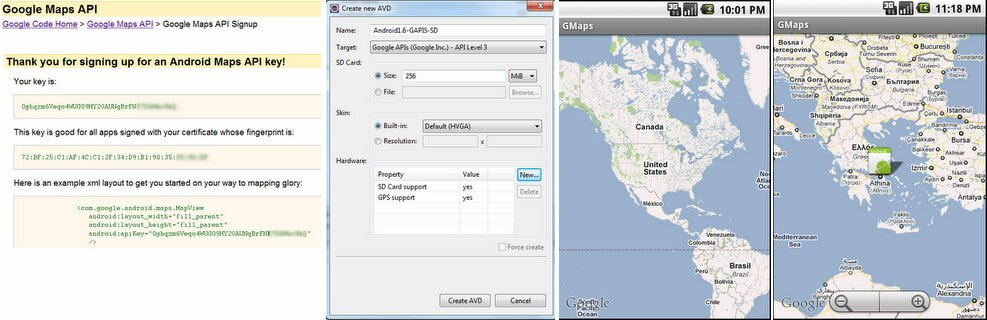
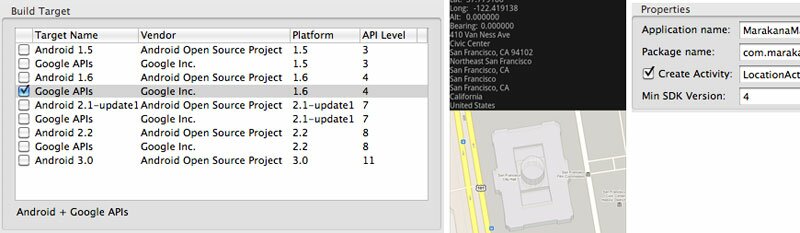
This tutorial will help you to start using location services (in particular: LocationManager class to get user location and Geocoder to translate location into addresses) and Google Maps on Android.
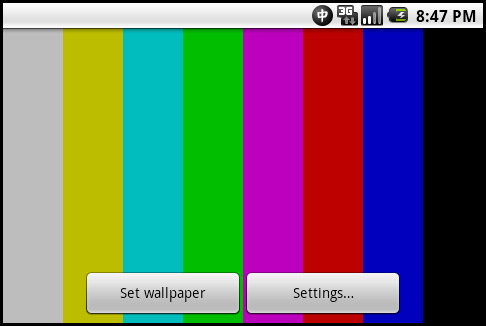
In this article tells how to create live wallpaper from scratch. Step-by-step, we will create live wallpaper that would output TV test pattern on out home screen.
4. Edit android_winusb.inf in C:\Android\usb_driver_r03-windows to match EVM/Beagle vendor and product ids. Under [Google.NTx86] for 32 bit machine or [Google.NTamd64] for 64 bit machine section add:
5. Boot the board as normal and wait until shell prompt is available (micro-B USB cable must be disconnected). Then connect micro-B USB cable between board and Windows PC.
6. If the device is detected automatically, install driver that was downloaded. Otherwise go to Windows Device Manager find the Rowboat device to update the driver.
There are lots of useful ADB shell commands which can run on UART window or Windows command line by "adb shell".
to copy a file or a directory recursively to emulator: adb push source destination
to copy a file or a directory recursively from emulator: adb pull destination source
OmniTouch turns any surface in the user’s environment into a touch interface. OmniTouch: Wearable Multitouch Interaction Everywhere—co-authored by Chris Harrison, a Ph.D. student at Carnegie Mellon University and a former Microsoft Research intern; Benko; and Andy Wilson—is a wearable system that enables graphical, interactive, multitouch input on arbitrary, everyday surfaces.
PocketTouch: Through-Fabric Capacitive Touch Input—written by Saponas, Harrison, and Benko—describes a prototype that consists of a custom, multitouch capacitive sensor mounted on the back of a smartphone. It uses the capacitive sensors to enable eyes-free multitouch input on the device through fabric, giving users the convenience of a rich set of gesture interactions, ranging from simple touch strokes to full alphanumeric text entry, without having to remove the device from a pocket or bag.
This 092311 release packageprovides a Andorid GingerBread 2.3.4 DevKit(GA) distribution with integrated SGX (3D graphics) drivers, Adobe Flash 10 support, TI hardware abstraction for video overlay, WLAN, Bluetooth support for WL1271, PowerManagement, S-Video, Camera on Beagle XM/AM37x EVM, RowboPERF performance measurement application, NAND (UBIFS), Fastboot and standard applications from Android.
The package also includes TI Android GingerBread Source, Linux Android kernel, Toolchain, Debug and Development Tools(CCSv5, ADT, Flashing Utility, etc) and Documentation to ease development, deployment and execution of Android based systems. The product forms the basis for all Android application development on AM37x, AM35x platforms.
Apple started a legal process several months ago to keep Samsung Tablets out of worldwide markets because the product looked similar to the iPAD. Samsung is the only company in the world that can challenge Apple on a vertical cost basis and they have the added advantage of having corporate subsidies. Apple’s goal in the coming year is to make Samsung retreat from the consumer market and back into semiconductors or risk losing an excessive amount of money. See more inSemiWiki.