Thursday, March 8, 2012

Comparison between iPAD 3 and Galaxy Note 10.1


Display
9.7 inch, Retina, 1536x2048 pixel, 241dpi
10.1 inch, S-Pen, PLS TFT capacitive, 1280x800, 149 dpi
Chip
dual core 1GHz processor with 512MB ~1GB of RAM, A5X chipset with a quad core graphics processing unit
dual core 1.4GHz processor with 1GB of RAM
Camera
3.15-megapixel primary at 2048x1536 pixels, 5-megapixel backside illuminated sensor, 5-element lens, IR filter, and ISP built in, 1080p video
5-megapixel backlight-illuminated sensor (BSI) at 2592x1944 pixels, 1080p video recording and a 2-megapixel secondary
Storage
16G, 32G, 64G
16, 32 and 64G, plus micro SD slot up to 32G
Connectivity
4G LTE
3G
OS
iOS 5.1
Android 4.0 ICS
Battery
14,000 mAh
 Li-Ion 7000 mAh


Galaxy Note vs iPad

Although the new iPAD 3 display is said to have a 44 per cent greater colour saturation compared to the old iPad 2/iPad display, but its color gamut still does not reach 50% of Adobe RGB gamut?

Wednesday, March 7, 2012

HEVC / H.265 Text Specification Draft 6, RTP Payload and HM-6.0rc1

High Efficiency Video Coding (HEVC) or H.265 under development by ISO / IEC Moving Pictures Experts Group (MPEG) and the ITU-T Video Coding Experts Group (VCEG), could reduce between a 25-50% the H.264 bitrate, as demonstrated by Qualcomm with a preliminary version of H.265 or HEVC video on an Android tablet powered by a current-generation Qualcomm Snapdragon S4 dual-core processor running at 1.5GHz.

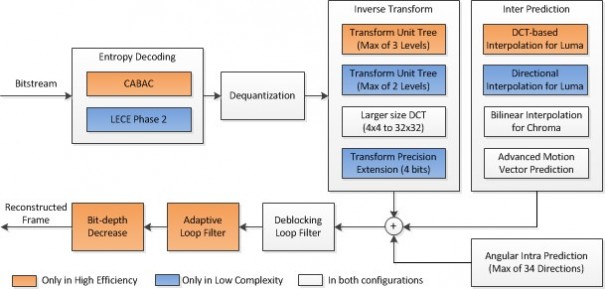
H.265 Decoding Framework

The latest HEVC or H.265 text specification draft 6 can be downloaded from the link. It includes a single profile, Main, which is similar to the Progressive High profile in H.264 AVC. The draft standard contains provisions for future extensions similar to Scalable Video Coding and Multiview Video Coding defined in H.264 AVC.

The corresponding RTP Payload Format draft for HEVC or H.265 defines an RTP payload format which allows for packetization of one or more Network Abstraction Layer (NAL) units in each RTP packet payload,  as well as fragmentation of a NAL unit into multiple RTP packets. Furthermore, it supports transmission of an HEVC stream over a single as well as multiple RTP flows. The payload format has wide applicability in videoconferencing, Internet video streaming, and high bit-rate entertainment-quality video, among others. It is similar to the H.264 Payload Format, referred to be RFC3984.

The latest HEVC reference software version is HM-6.0rc1.

iPAD 3 Records 1080p Video Using Quad-core Processor With 2048x1536 Retina Display

The new iPad announced today comes with rich multimedia capabilities:
  • Retina display with a resolution of 2048 x 1536, which includes 3.1 million pixels;
  • The 5MP iSight camera technology from the iPhone 4S;
  • 1080p video recording;
  • A5X quad-core processor;
  • Siri from the iPhone 4S, the voice recognition to the iPad, allowing voice dictation of emails;
The prices for the iPad remain unchanged at $499 for the 16GB with wifi, $599 for 32GB wifi and $699 for the 64GB model with wifi. Models with 4G are priced at $629/$729/$829 for 16GB/32GB/64GB configurations.

IDC Releases First Worldwide Big Data Technology and Services Market Forecast

IDC predicted that Big Data market will be big and grow from $3.2 billion in 2010 to $16.9 billion in 2015. This represents a compound annual growth rate (CAGR) of 40% or about 7 times that of the overall information and communications technology (ICT) market.

According to a study conducted by MGI (McKinsey Global Institute), if US healthcare were to use big data creatively and effectively to drive efficiency and quality, the sector could create more than $300 billion in value every year. Two-thirds of that would be in the form of reducing US healthcare expenditure by about 8 percent. In the developed economies of Europe, government administrators could save more than €100 billion ($149 billion) in operational efficiency improvements alone by using big data, not including using big data to reduce fraud and errors and boost the collection of tax revenues. And users of services enabled by personal-location data could capture $600 billion in consumer surplus.

"The Big Data market is expanding rapidly as large IT companies and startups vie for customers and market share," said Dan Vesset, program vice president, Business Analytics Solutions at IDC. "For technology buyers, opportunities exist to use Big Data technology to improve operational efficiency and to drive innovation. Use cases are already present across industries and geographic regions.

"There are also Big Data opportunities for both large IT vendors and start ups," Vesset continued. "Major IT vendors are offering both database solutions and configurations supporting Big Data by evolving their own products as well as by acquisition. At the same time, more than half a billion dollars in venture capital has been invested in new Big Data technology."

Additional findings from IDC's study include the following:
  • While the five-year CAGR for the worldwide market is expected to be nearly 40%, the growth of individual segments varies from 27.3% for servers and 34.2% for software to 61.4% for storage.
  • The growth in appliances, Cloud, and outsourcing deals for Big Data technology will likely mean that over time end users will pay increasingly less attention to technology capabilities and will focus instead on the business value arguments. System performance, availability, security, and manageability will all matter greatly. However, how they are achieved will be less of a point for differentiation among vendors.
  • Today there is a shortage of trained Big Data technology experts, in addition to a shortage of analytics experts. This labor supply constraint will act as an inhibitor of adoption and use of Big Data technologies, and it will also encourage vendors to deliver Big Data technologies as cloud-based solutions.
"While software and services make up the bulk of the market opportunity through 2015, infrastructure technology for Big Data deployments is expected to grow slightly faster at 44% CAGR. Storage, in particular, shows the strongest growth opportunity, growing at 61.4% CAGR through 2015," said Benjamin S. Woo, program vice president, Storage Systems at IDC. "The significant growth rate in revenue is underscored by the large number of new open source projects that drive infrastructure investments."

See the IDC "Worldwide Big Data Technology and Services 2012–2015 Forecast" report for detail.

Monday, March 5, 2012

Nokia Unveils 41-megapixel 808 PureView Smartphone

At Mobile World Congress 2012,  Nokia ushered in a new smartphone imaging with the Nokia 808 PureView.  This is the first smartphone to feature Nokia PureView imaging technologies, bringing together high resolution sensors, exclusive Carl Zeiss optics and Nokia developed algorithms, which will support new high-end imaging experiences for future Nokia products.

Nokia 808 PureView lens

The Nokia 808 PureView features a large, high-resolution 41 megapixel sensor with high-performance Carl Zeiss optics and new pixel oversampling technology.  At standard resolutions (2/3, 5 and 8 megapixels) this means the ability to zoom without loss of clarity and capture seven pixels of information, condensing into one pixel for the sharpest images imaginable.  At high-resolution (38 megapixel maximum, 7,152 by 5,368 pixels) it means the ability to capture an image, then zoom, reframe, crop and resize afterwards to expose previously unseen levels of details. The default mode records 5-megapixel images by condensing seven pixels into one, but you can turn off that default and get 38-megapixel pictures if you feel you can handle the file size. The 5-megapixel mode offers dramatically reduced low light noise and improved image quality because it's oversampling, though, and that's the mode Nokia thinks most people will be using most often.

In addition to superior still imaging technology, the Nokia 808 PureView, also includes full HD 1080p video recording and playback with 4X lossless zoom and the world's first use of Nokia Rich Recording.  Rich Recording enables audio recording at CD-like levels of quality, previously only possible with external microphones. The Nokia 808 PureView also features exclusive Dolby Headphone technology, transforming stereo content into a personal surround sound experience over any headphones and Dolby Digital Plus for 5.1 channel surround sound playback.
Nokia 808 PureView with 41 MP camera
Nokia 808 PureView

Video codecs and formats
  • H.264 (base profile, main profile, high profile), MPEG-4, VC-1, Sorenson Spark, Real video 10
  • Streaming: H.264, Flash Lite 4 (Flash 10 compatibility for video), On2 VP6, Sorenson Spark
Other specs can be found in the Nokia website.

Sunday, March 4, 2012

Qualcomm Demonstrates HEVC / H.265 Video Codec on Android Tablet

At the Mobile World Congress 2012 show in Barcelona, Qualcomm demonstrated a preliminary version of H.265 or HEVC video on an Android tablet powered by a current-generation Qualcomm Snapdragon S4 dual-core processor running at 1.5GHz.

H.264 is today's leader when it comes to mainstream video encoding technologies, but it will have to share the stage in 2013 with a successor called H.265 that can squeeze a video into nearly half the file size. H.264, also known as the Advanced Video Codec (AVC), defines how a video can be compressed for reduced storage requirements and--very importantly given the online video explosion--for streaming across networks. H.265, also called High Efficiency Video Codec (HEVC), uses new techniques to compress video even more.

The H.265 codec is likely to gain widespread support, but it and H.264 competes with a royalty-free alternative called VP8 that Google has released. Qualcomm competitor Nvidia has built VP8 decoding support into its newer Tegra 3 chips alongside H.264 support.

Qualcomm is bullish about the codec. If a given network capacity can sustain higher-quality video, that means mobile devices are better for entertainment. And because H.265's efficiencies come at the cost of a significantly higher need for processing power, mobile device makers have a new reason to buy the latest chips.

Qualcomm showed a software based encoded demo video, showing race cars peeling around a track, played at a bit rate of 610 kilobits per second on H.265 compared to 1,183Kbps for H.264. The size of the video file itself was 3.10MB for H.265 vs 6.01MB for H.264. Each video had 800x480-pixel resolution. Qualcomm will build H.265 encoding into its chips, though it is not promised when or in which processor model.

See more at a CNET report.


Thursday, March 1, 2012

One-click Root for Asus Transformer Prime on Android 4.0.3 (ICS 9.4.2.15 Firmware)


Thanks to XDA-Developers member -viperboy-, viperMOD Prime Time has been updated to work on the latest Android 4.0.3 (Ice Cream Sandwich) - 9.2.4.15 firmware. It is very simple to use and is one-click rooting tool.

(1) Requirements:

  • Download tools from Windows or Linux.
  • Make sure that USB Debugging is enabled on the tablet. This is possible by going to Settings > Developer Options
  • Make sure tablet is at least 70% charged

(2) Windows Procedures

  • Unzip the contents to a new folder
  • Kill Splashtop and Asus Sync and connect the tablet to the PC via the USB cable
  • Install all the drivers located in the new folder including the adb driver
  • Run PrimeTime.exe for windows users. A command prompt line will show up

(3) Linux Procedures

  • Unzip the contents to a new folder
  • chmod a+x for all files
  • run the script primetime.sh under the root user

Type 1 to begin the rooting process.

Once done, install OTA ROOT KEEPER from Android App market.

With the help of OTA Root Keeper, you’ll have a backup of your device’s root and will allow your root to survive OTAs.

Followers

About Me

My photo
HD Multimedia Technology player